


Effective 1 February 2026, the National Social Security Fund (NSSF) has transitioned into Year 4 of the phased rollout under the NSSF Act No. 45 of 2013. These changes represent a significant shift in payroll deductions, employer liability, and net take-home pay for the Kenyan workforce.
For HR professionals and business owners, compliance is no longer just about remitting—it’s about precision. This guide breaks down the new limits, the math behind the tiers, and how KaziQuest simplifies this transition.
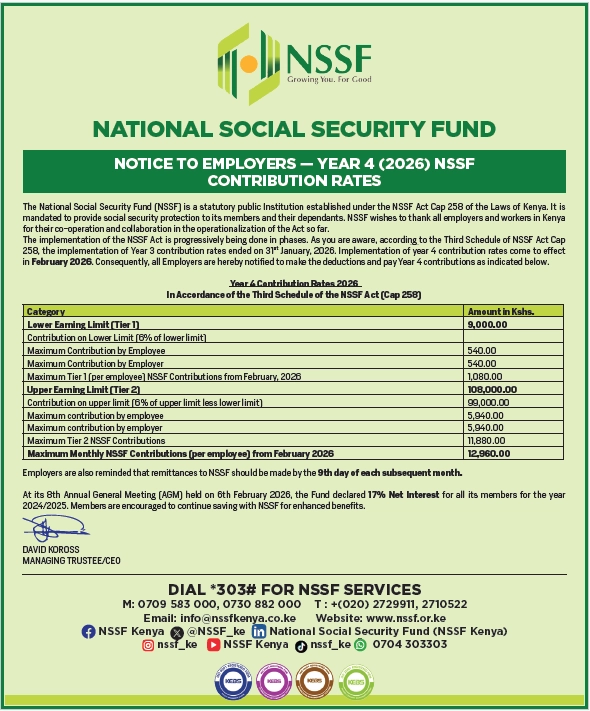
Quick Summary: NSSF Rates (Year 4 Rollout)
Category | New Monthly Rate (Feb 2026) |
Tier I Lower Earnings Limit | KSh 9,000 |
Tier II Upper Earnings Limit | KSh 108,000 |
Employee Contribution (Combined) | 6% of Pensionable Pay (Max KSh 6,480) |
Employer Matching (Combined) | 6% of Pensionable Pay (Max KSh 6,480) |
Total Combined Remittance | KSh 12,960 (Max) |
What Changed in February 2026?
The Year 4 implementation focuses on increasing the “Earnings Limits” rather than the percentage rate. While the deduction remains at 6%, the volume of income subject to that 6% has expanded.
- Lower Earnings Limit (Tier I): Increased from KSh 8,000 to KSh 9,000.
- Upper Earnings Limit (Tier II): Increased from KSh 72,000 to KSh 108,000.
- The Goal: These adjustments align statutory savings with the rising cost of living and long-term social security sustainability in Kenya.
How to Calculate NSSF Contributions
NSSF contributions are split into two “Tiers.” Understanding this distinction is vital for accurate PAYE (Pay As You Earn) calculations, as NSSF is a tax-deductible expense.
Strategic Insights for HR & Business Owners
1. The “Contracting Out” Option
Under the NSSF Act, employers have the option to “Contract Out” Tier II contributions. This means you can opt to remit Tier II funds into a Registered Retirement Benefits Scheme rather than NSSF, provided the scheme is approved by the Retirement Benefits Authority (RBA). Tier I MUST always go to NSSF.
2. Impact on Take-Home Pay vs. Tax
While employees will see a higher NSSF deduction, remember that NSSF is tax-exempt. Higher NSSF contributions reduce the “Taxable Pay,” which slightly lowers the amount of PAYE tax the employee owes.
3. Increased Cost of Employment (COE)
For businesses with many high-earning staff, the jump from a KSh 72,000 limit to a KSh 108,000 limit represents a notable increase in overhead. Ensure your 2026 budgets account for the extra KSh 2,160 per high-earning employee compared to last year.
Automate Compliance with KaziQuest
Manual payroll calculations are the leading cause of non-compliance penalties in Kenya. With the February 2026 changes, the margin for error is slim.
How KaziQuest Solves This:
- Automatic Updates: Our system has already been patched with the 2026 Year 4 limits. You don’t need to touch a single setting.
- Tiered Accuracy: KaziQuest automatically splits Tier I and Tier II for seamless reporting.
- One-Click Remittance: Generate your NSSF return files in the exact format required by the NSSF self-service portal.
Frequently Asked Questions
Q: What is the deadline for February 2026 remittances?
A: All NSSF contributions must be remitted by the 9th of the following month. For February 2026, the deadline is 9 March 2026.
Q: Does this affect casual laborers?
A: Yes. All employees in the formal sector, regardless of contract type, are subject to these statutory deductions if they meet the earnings threshold.
Q: Will the rates change again in 2027?
A: This 2026 update is the final phase of the initial 4-year plan. Any future changes will depend on new government directives or amendments to the NSSF Act.
Your Compliance Checklist
- Communicate: Send a memo to staff explaining the slight change in net pay (emphasizing the pension gain!).
- Audit Payroll: Ensure your current software is updated for the KSh 108,000 ceiling.
- Communicate: Send a memo to staff explaining the slight change in net pay (emphasizing the pension gain!).
- Budget Review: Update your finance department on the increased employer matching costs.
- Switch to KaziQuest: If you’re still using Excel, now is the time to automate.
Ready to streamline your HR? Try It Free
Book a demo with KaziQuest today and see how we make Kenyan payroll compliance effortless.
